Every August, the internet fills up with color-coded calendars, perfectly packed lunches, and morning routines that apparently involve children cheerfully putting on their shoes the first time they’re asked.
That is not my house.
In a neurodivergent family, back-to-school organization isn’t simply about becoming more disciplined. ADHD, autism, anxiety, PDA profiles, and other differences can affect working memory, task initiation, transitions, sensory processing, and our ability to sequence seemingly simple tasks.
And then there’s a frustrating paradox many families know well.
Some neurodivergent children also have co-occurring medical, gastrointestinal, feeding, or metabolic concerns that mean food can’t always come from a drive-through or a box. Some families are navigating medically prescribed diets, food allergies, ingredient restrictions, or simply bodies that function better when they’re consistently fed nutrient-dense, home-cooked food.
So the child who may struggle most with planning, sequencing and preparing food may also need more food prepared at home.
And the parent managing that child’s appointments, therapies, school supports and nervous-system needs is somehow supposed to cook it all.
That’s exactly why we need systems.
Instead of asking, “How do I make my kids more organized?” I’m asking:
How can I make our home require less organization from their brains—and mine?
That’s what I call Command Calm.
The Kitchen Can Help Us Heal
Food is one of the most repetitive demands of parenting. Everyone needs to eat again tomorrow, regardless of how overwhelmed we are today.
But that repetition can become an advantage.
The kitchen gives us opportunities to build predictable rhythms while teaching real-life executive-function skills: planning, sequencing, measuring, timing, cleaning and caring for ourselves.
Instead of making the kitchen another place our kids need to “get it together,” we can make it a place that helps them succeed.
1. Make the Invisible Visible
For some brains, food hidden behind other food might as well not exist.
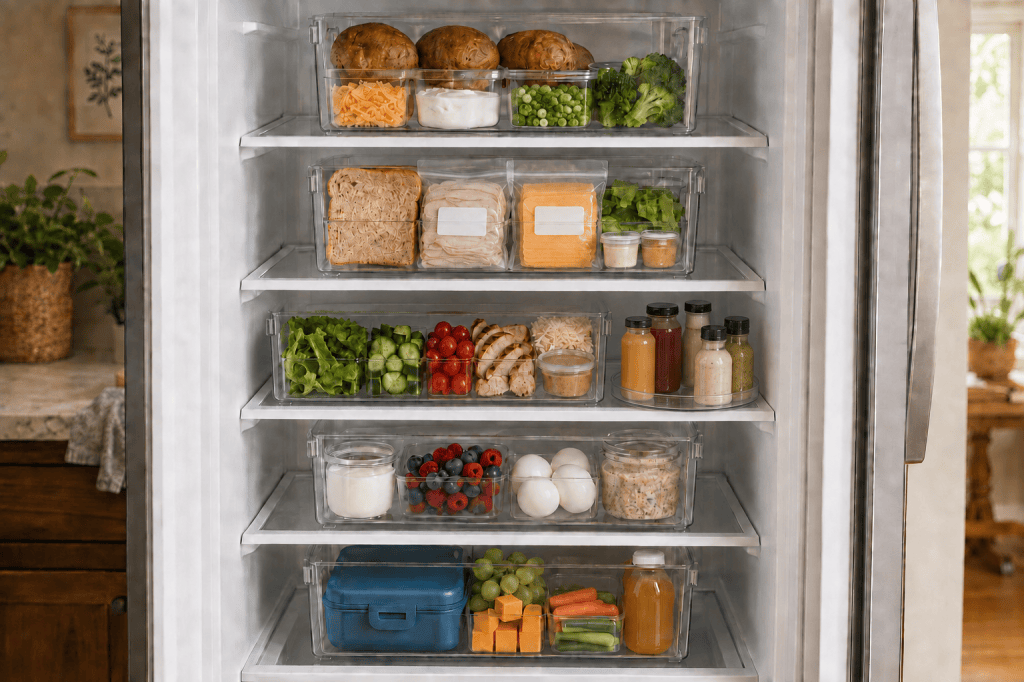
That’s why I love lazy Susans (affectionally renamed high effective Susans in our house) for drinks and salad dressings and clear refrigerator bins.
But don’t organize your refrigerator for Pinterest. Organize it according to how your family actually eats.
The goal isn’t a beautiful refrigerator.
The goal is making the next step obvious.
2. Build DIY Meal Bins
Instead of keeping cheese in one drawer, vegetables in another and proteins somewhere else, group ingredients around complete meals.
Try:
Baked Potato Bar: cooked potatoes, shredded cheese, bacon, sour cream, broccoli and approved toppings.
Sandwich Bin: deli meat, sliced cheese, vegetables, spreads and condiments, with bread nearby.
Salad Bin: greens, chopped vegetables, protein, cheese, toppings and dressing.
Taco Bowl Bin: cooked meat or beans, rice, cheese, salsa and toppings.
Now “make yourself lunch” isn’t an abstract task requiring a child to mentally inventory an entire kitchen.
It’s:
Choose a bin. Pull it out. Build your meal. Put it back.
For families following specific medical diets, the same concept becomes even more useful. Stock each kit entirely with foods that work for your child’s prescribed diet or allergy plan. Instead of constantly explaining what they can’t choose, you’re creating an environment full of things they can.
That’s externalized executive function—and growing independence.
3. Use Meal Kits to Teach Cooking
When appropriate for your family’s dietary needs, meal-delivery kits can also be a surprisingly useful teaching tool.
Pre-portioned ingredients remove some of the hardest executive-function demands: deciding what to make, creating a grocery list, finding every ingredient and figuring out the sequence.
Let your tween or teen take responsibility for one dinner.
They’re practicing reading, sequencing, measuring, food safety, timing and cleanup.
More importantly, they’re learning:
I can feed myself.
For families who need to cook from scratch, you can create your own version: portion the ingredients for a familiar recipe together and let your child work through a simple visual recipe card.
4. Meal Prep With Your Kids
If home cooking is medically important in your house, Mom becoming the family’s exhausted short-order cook isn’t a sustainable solution.
Bring the kids into the system.
One child washes fruit. Another preps potatoes. Someone portions ingredients. A teen doubles a dinner recipe so half can go into the freezer.
You’re not just getting Sunday’s prep done.
You’re teaching children how to eventually manage the very dietary needs their bodies may require them to understand for themselves.
That’s not a chore chart.
That’s healthcare becoming a life skill.
5. Organize for Function, Not Aesthetics
Neurodivergent-friendly organization prioritizes what makes the next action obvious.
Clear containers instead of opaque ones.
Hooks instead of hangers.
Frequently used dishes within reach.
Visual labels.
Fewer steps.
If your gorgeous organizational system requires six steps to maintain, nobody in an overwhelmed household is going to maintain it.
Reduce the friction.
6. Take Command Calm Beyond the Kitchen
Create a school launch pad near the door.
Backpacks. Shoes. Water bottles. Library books. Sports equipment. Anything that needs to leave tomorrow gets one predictable home.
Eventually, the environment itself starts carrying part of the family’s working memory.
And that’s the larger lesson. When our environment doesn’t fit us, we can adapt our environment! This approach works equally well for minivan moms and sports families- consider a crock pot adapter and throw one of those premade freezer meals in the car for dinner on the go. Pack a designated bag of all the extras needed from hair care to socks and shin guards if going back home for forgotten items is not in the cards. Have a kiddo that requires no food touching and a hot lunch? We have the technology with these bento style electric lunch boxes!
Calm Is a System, Not a Personality Trait
Our kids don’t need another adult telling them to “just remember.”
And parents navigating neurodivergence, medical diets, school accommodations and ordinary family life don’t need another impossible standard to meet.
We need homes designed around the brains and bodies actually living in them.
Add the clear bin.
Put dinner ingredients together.
Move the hooks lower.
Write down the steps.
Cook together.
Freeze the second batch.
Make tomorrow easier while you’re already doing today’s work.
Because partnering with neurodivergence doesn’t mean lowering expectations for independence.
It means building the scaffolding that makes independence possible.
The opposite of chaos isn’t control.
It’s connection.
This post may contain affiliate links. If you purchase through one of these links, I may earn a small commission at no additional cost to you. I only share products I believe can make family life easier.


