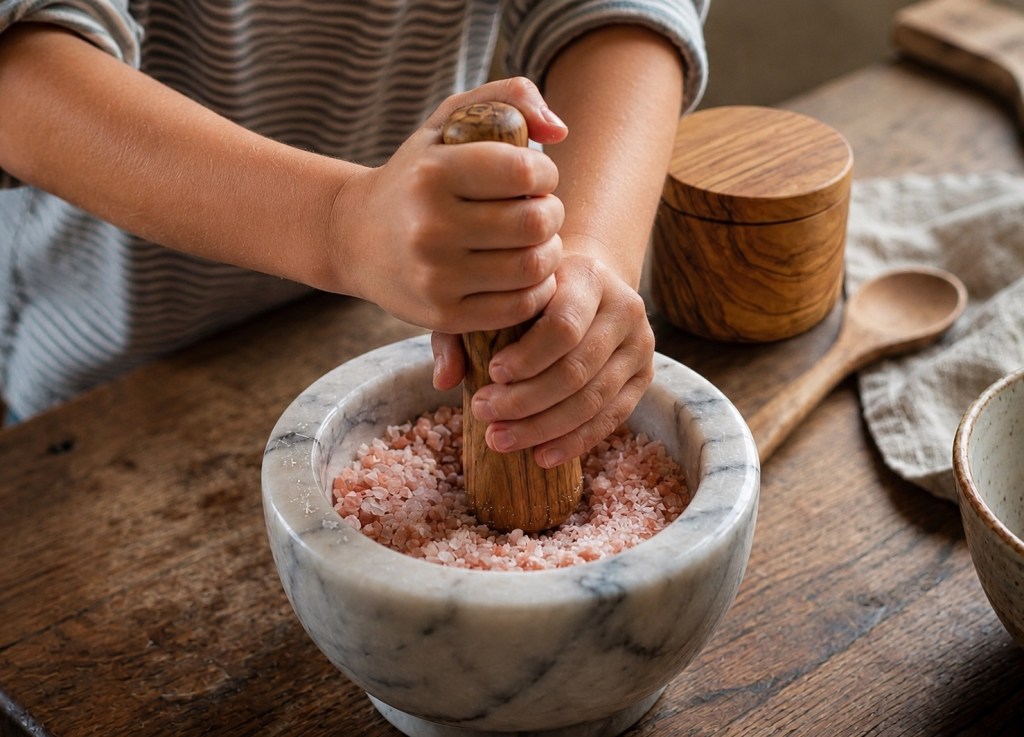
One of the greatest gifts I’ve given my sons wasn’t expensive.
It wasn’t a new toy.
It wasn’t a supplement.
It wasn’t even a destination vacation.
It was a $9 mortar and pestle.
Every week, one of my boys pours Himalayan pink salt crystals into a marble mortar and begins grinding. The rhythmic sound fills the kitchen while we talk about our week, what’s growing in the garden, or what’s for dinner that night.
A few minutes later, our salt cellar is full again.
It’s a tiny task.
But it has never really been about the salt.
When E.’s neuroimmune journey began years ago, I quickly realized that healing wasn’t just about doctors, medications, or eliminating foods. Those things mattered, but so did something much less obvious.
Children need to feel capable.
They need to know they aren’t simply receiving care—they’re helping create it.
Because our family follows a neuroimmune diet, I prepare many of our seasonings from scratch. We grow herbs and vegetables so my boys can eat food harvested at its nutritional peak while reducing pesticide exposure whenever possible. Rather than shielding them from those routines, I invited them into them.
I never wanted our neuroimmune journey to become something that simply happened to us. Instead, I wanted it to become something we intentionally participated in—one small choice at a time. This wasn’t a life we had to endure. It became the way we protect our peace.
Grinding salt became one of those invitations.
It’s a meaningful contribution to our home.
It teaches practical life skills.
It develops fine motor strength and coordination.
It creates space for conversation.
Most importantly, it builds confidence.
Over time, it has quietly taught something even more important:
Food isn’t something that happens to E.
It’s something he has the knowledge and confidence to participate in.
As E. has grown older, that understanding has become part of his identity. He knows why we choose certain ingredients. He understands how food can influence the body. He has learned that caring for himself doesn’t begin with perfection—it begins with participation.
That doesn’t mean the responsibility rests on his shoulders. He is still a child, and I remain responsible for creating a food environment that supports his health. I choose the foods that come into our home and set the standards that help keep him safe. Inviting him into that process isn’t about asking him to manage his medical needs—it’s about equipping him with the knowledge and practical skills he’ll carry into adulthood.
These rituals have served another purpose I didn’t fully appreciate when I first began them.
Children thrive on predictable rhythms. Repeated rituals create a sense of security because they answer a question every child is constantly asking: Where do I belong?
For children navigating chronic illness, neurodevelopmental differences, anxiety, or transitions between two homes, those rhythms become emotional anchors. They offer continuity when so much else feels outside a child’s control.
The ritual itself isn’t what matters.
The consistency is.
Whether your child helps grind salt, waters tomatoes before breakfast, harvests basil for dinner, feeds the chickens, or stirs pancake batter every Saturday morning, they’re doing far more than completing a chore.
They’re building competence.
They’re developing self-efficacy.
They’re strengthening attachment.
They’re learning that they have something meaningful to contribute to the people they love.
As parents, we often search for the next big intervention.
I’ve learned that some of the most powerful ones fit in the palm of your hand.
A mortar.
A pestle.
A handful of salt.
Sometimes the smallest rituals become the strongest foundations.
Because the opposite of chaos isn’t control.
It’s connection.


